Bats are not blind. Some use echolocation to navigate and locate food, while eyesight also matters. Bat species vary, so do not give every bat the same diet or sensory description.
A Halloween decoration may show a bat as a mysterious shape with glowing eyes. A real animal question deserves a calmer explanation. Begin by separating “uses sound” from “cannot see”—those are not the same statement.
Use a reliable bat explanation
San Diego Zoo Wildlife Alliance’s bat guide identifies bats as flying mammals and corrects common myths. It describes excellent eyesight in many larger fruit-eating bats and echolocation in many smaller insect-eating bats. This is enough to explain that echolocation does not mean blindness. Avoid treating the guide’s broad comparison as an identical description of every species.
Observe a real photograph
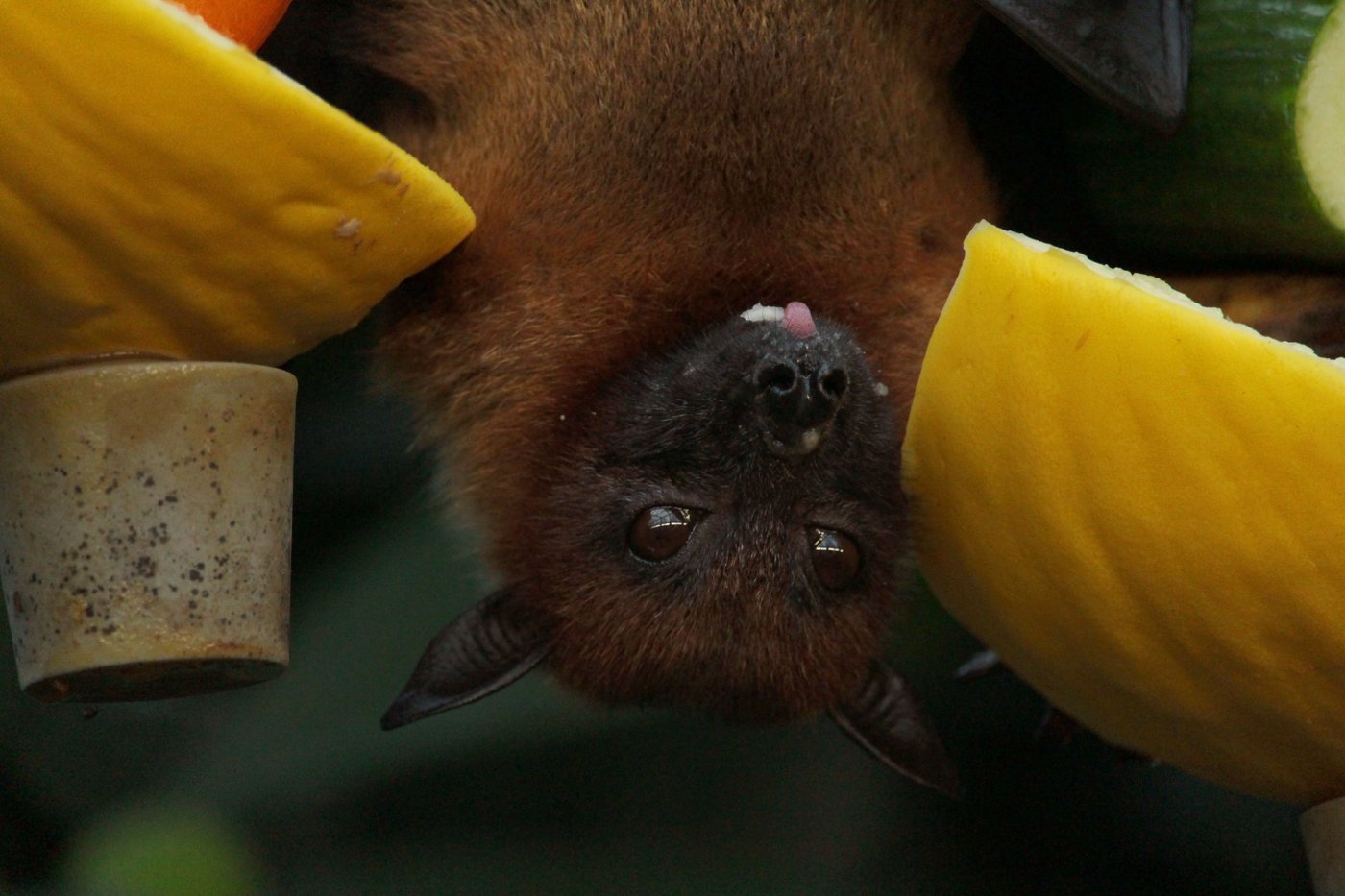
The credited stock photo shows a bat hanging upside down with fruit. Notice a visible eye, ear, and part of a folded wing. The image supports those visible observations; it does not show how this individual navigates in flight.
Ask “What can we see?” before “What might it do?” A child can point rather than answer in a sentence. Keep species labels cautious if the photo’s general description does not establish the exact species.
Make a two-column question page
- Divide a sheet into “I can see” and “I learned.”
- In the first space, sketch a head, ear, and visible eye from the photo.
- In the second, write or dictate the short answer that bats are not blind.
- Add a question mark for something you still want to check.
The distinction is useful because a still photograph and a written reference answer different questions. Do not draw sound waves around the pictured bat as if the photo proves that exact behavior.
Try an imaginary sound diagram separately
If your child wants a diagram, draw an original pretend bat, a nearby object, and an outward arrow with a return arrow. Label it a simplified model of using returning sound. You do not need to imitate bat frequencies or conduct a hearing experiment.
A helpful response to the myth
Try “Using sound can help a bat find things, but it does not mean the bat has no sight.” Repeat the distinction once, then let the child return to drawing.
Frequently asked questions
Do all bats eat fruit?
No. The linked guide describes different diets. The fruit in this photograph should not become a rule for all bats.
Should we find a real bat?
This is a picture-and-source activity. It does not require approaching, touching, feeding, or disturbing a bat.
Is the drawing an identification guide?
No. An original sketch can show selected features without accurately identifying a species. Use an appropriate species guide for that separate task.
Connect the idea with a real book preview
Your own paper is enough for this activity. A ready outline is another option when your child prefers coloring to drawing. Preview Baby Animals, the first adventure presented in Little Wonder Club’s Wild Little Wonders series. The current site lists an English 8.5 × 11-inch paperback for ages 4–8, with 40 baby animals, short facts, and 88 total pages. These companion activities are original journal ideas; check the preview for the book’s actual contents.
View the paperback and current ordering details on Amazon.
Keep exploring
Illustrative stock photograph by Miriam Fischer on Pexels, under the free Pexels License. It does not show our book or demonstrate the exact activity. Sources and book details checked October 12, 2026.
Explore Baby Animals
See the actual inside pages before deciding whether the book fits your child.
Check the paperback on Amazon